Architecture: threads and buffers
Each stage of the DSP chain, plus I/O and the UI, runs in its own thread; stages exchange data through power-of-two circular buffers.
Threads#
Thread identities and states are in thrdef.h. The DSP-path threads:
| Thread | Purpose |
|---|---|
THREAD_RX_ADINPUT / THREAD_*_INPUT |
device / network / file input → fills timf1 |
THREAD_DO_FFT1C, THREAD_FFT1B1..6 |
first FFT, spread over up to 6 workers |
THREAD_TIMF2 |
do_fft1_c() → make_timf2() → first_noise_blanker() |
THREAD_SECOND_FFT |
recombine the two timf2 parts → fft2; AFC / spur removal |
THREAD_NARROWBAND_DSP |
first mixer / AFC, timing |
THREAD_MIX2 |
second mixer + baseband (do_mix2 → fft3_mix2) |
THREAD_FFT3 |
third FFT feeding the second mixer |
THREAD_RX_OUTPUT, THREAD_BLOCKING_RXOUT |
resample + demodulate → D/A |
THREAD_SCREEN, THREAD_USER_COMMAND |
display and UI |
Synchronization uses atomic status/command flags, an event set (lir_await_event / lir_set_event), and a small set of mutexes.
In the source
Thread IDs from thrdef.h:47; thread states (THRFLAG_*) thrdef.h:6; atomic flag helpers (lir_interlocked_*) thrdef.h:184; events (EVENT_*) thrdef.h:125; mutexes thrdef.h:162. The narrow-band trio is created together at menu.c:702. OS-specific thread bodies are in lxsys.c (Linux) and wsys.c (Windows); they call the portable DSP entry points (e.g. lxsys.c:1397 do_mix2()). Per-thread CPU/wall time (thread_tottim*, thread_cputim*) is shown when T is pressed (z_TIMING.txt).
Circular buffers#
The conventions (z_BUFFERS.txt):
- A buffer
xxxmay be aliased by type —xxx_char,xxx_short_int/xxx_shi,xxx_int,xxx_float— all pointing at the same memory; the active type depends onswfloatand the stage. - Sizes:
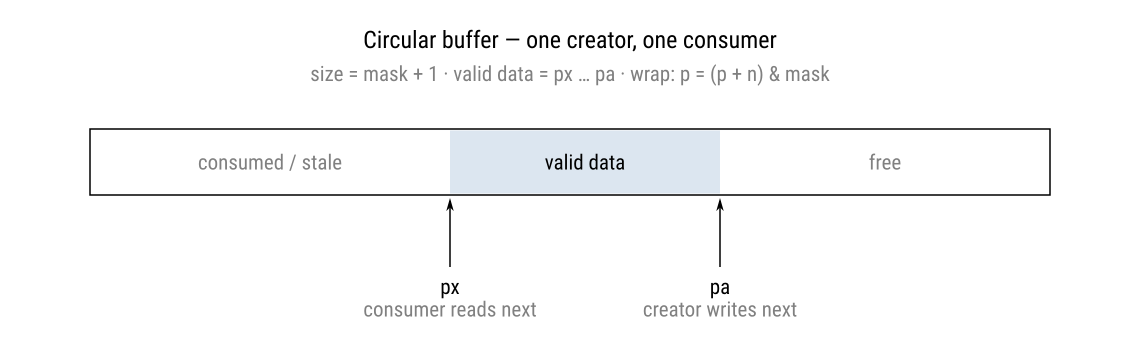
xxx_size(elements),xxx_bytes,xxx_mask = size-1(for&-wrap),xxx_block(one update). - One creator owns
xxx_pa(next write position); one consumer ownsxxx_px(next read position). Valid data occupiespx … pa;px == pais empty. Wrapping isp = (p + n) & mask. - Extra users/modifiers keep their own named pointers (e.g.
timf2p_fit).
The main DSP buffers, in order:
timf1 → fft1 → (split) → timf2 → fft2 → timf3/fft3 → baseb → daoutThe T display lists the same buffers as delay times: Raw(timf1) → fft1 → timf2 → fft2 → timf3 → fft3 → baseb → buf(daout) → D/A.
In the source
Buffer naming/conventions: z_BUFFERS.txt. Delay-time readout: z_TIMING.txt. The timf2 buffer and its pointers (timf2_pa, timf2_px, timf2p_fit, timf2_mask, …) are declared in fft1def.h:273.