First FFT and the strong/weak channel split
The split separates strong signals from weak signals + noise before the noise blanker runs, so the blanker sees impulse noise without strong signals swamping it. From z_SETTINGS.txt:
If the second FFT is enabled, the transforms of the first FFT are split into two sets of transforms. Both sets are back transformed to produce two functions of time, one of which contains all strong signals … while the other contains impulse noise and weak signals.
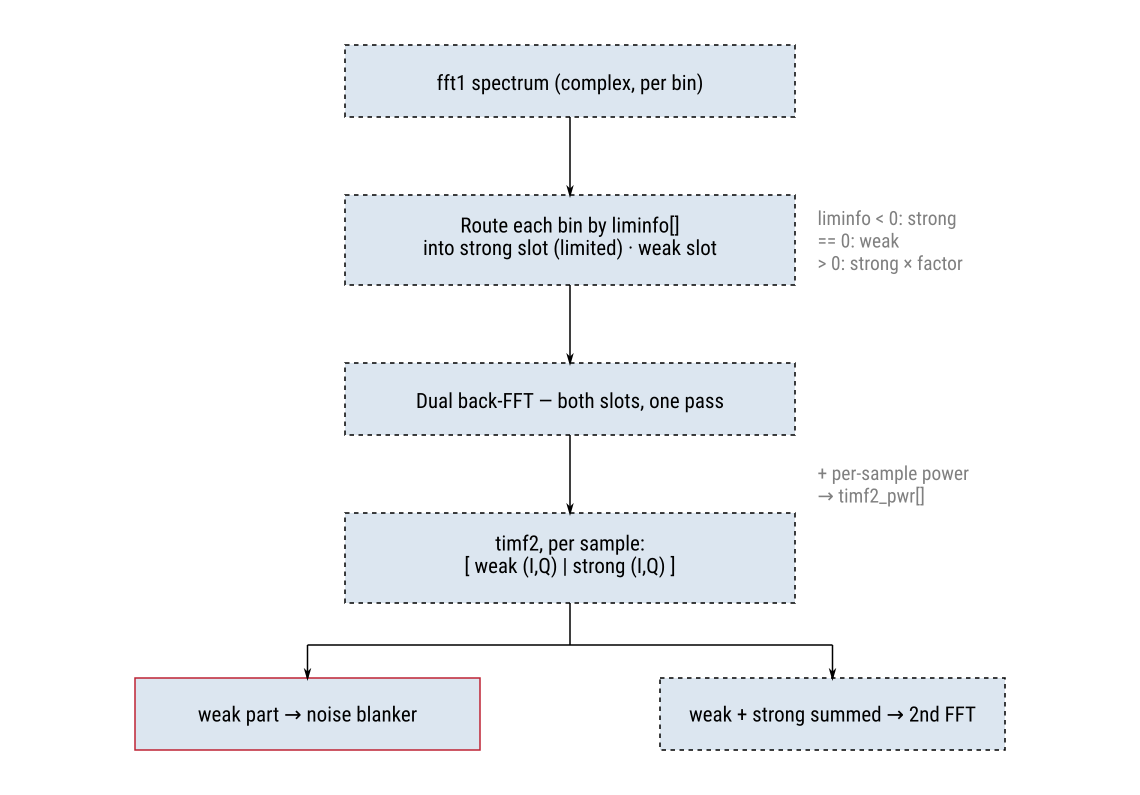
First FFT#
The first FFT (fft1.c, driven from wcw.c) transforms timf1 into the wideband complex spectrum fft1 and the spectrum/waterfall. Its analysis window fft1_window (a sin^p power set by genparm[FIRST_FFT_SINPOW]) doubles as the anti-alias filter for the later decimation, so power ≥ 2 is needed for good spur suppression. Transforms overlap in time by fft1_interleave_points (= fft1_size/2 for a sin^2 window). The FFT can be spread over up to 6 worker threads or run on a GPU.
Classifying each bin: liminfo[]#
The routing decision for each first-FFT bin is stored in the float array liminfo[] (sellim.c:79):
liminfo[i]  < 0  →  strong slot, amplitude factor = 1
liminfo[i] == 0  →  weak slot   (blanker input)
liminfo[i]  > 0  →  strong slot, amplitude factor = liminfo[i]   (< 1, limited)
Two producers set it: fft2_update_liminfo() — the automatic level limiter, using the finer fft2 resolution to mark and scale strong bins — and selfreq_liminfo(), which forces the selected passband into a chosen class.
Because some bins are moved to the strong slot, the weak-signal time function is built from a reduced bandwidth, so a pulse there is weaker and longer than the stored reference assumes. liminfo_amplitude_factor compensates the blanker's amplitude estimate; if ≥ 50 % of bins are strong, the clever blanker is skipped.
In the source
liminfo meaning: sellim.c:79. Automatic limiter: fft2_update_liminfo() — sellim.c:159, tuned by hg.sellim_par1..8 and genparm[SELLIM_MAXLEVEL]. Passband forcing: selfreq_liminfo() — sellim.c:38. liminfo_amplitude_factor: sellim.c:117 (the half-bandwidth amplitude note is at sellim.c:124).
Split and back-transform: make_timf2()#
make_timf2() (timf2.c:31) writes each bin into one of two interleaved slots. For one channel the split array is 4 floats per bin — (weak_re, weak_im, strong_re, strong_im); for two channels it is 8. Bins outside the band are zeroed in both slots.
fft1back_one() / fft1back_two() inverse-transform both slots in one pass (the butterflies operate on the interleaved words). fft1back_fp_finish() overlap-adds the result into the timf2 circular buffer:
sin^2window: overlapping halves are simply added (sin²+cos²=1) — exact reconstruction with no window division;- arbitrary window: multiply by the inverted window and keep the central portion.
While writing each sample it also stores the per-sample power into timf2_pwr[], which is what the noise blanker scans.
timf2 layout per time sample: one channel timf2[4k+0..1] = weak (I,Q), timf2[4k+2..3] = strong; two channels timf2[8k+0..3] = weak (ch1, ch2), timf2[8k+4..7] = strong.
The two parts are added back into one time function for the second FFT, so the split is transparent to everything downstream of the blanker.
In the source
Split (float, one channel): timf2.c:39; two channels: timf2.c:77; the 16-bit path uses split_one() / split_two() (split.s). Back-transform: fft1back_one() — timf2.c:689; fft1back_two() — timf2.c:210. Overlap-add and per-sample power: fft1back_fp_finish() — timf2.c:970 (sin^2 add at timf2.c:1003); scale factor ampfac = 1/(1<<genparm[FIRST_BCKFFT_ATT_N]) at timf2.c:976. fft1_lowlevel_fraction (weak-slot fraction) at timf2.c:205. Recombination for the second FFT is in make_fft2() (driven from wcw.c:250).