Diversity and adaptive polarization
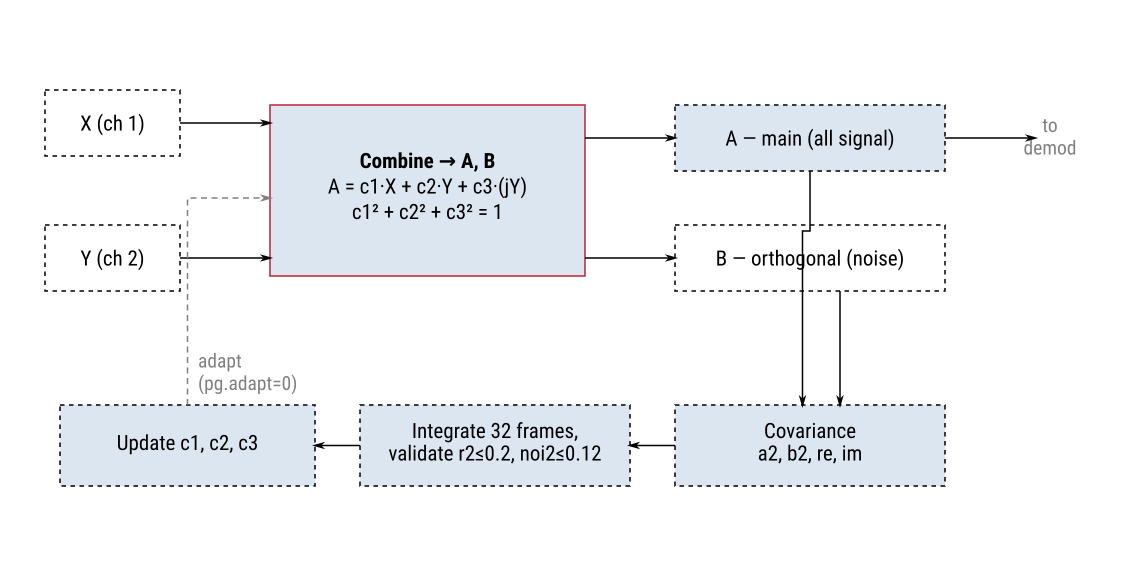
With two coherent RF receivers sharing a common local oscillator, Linrad combines the two channels sample-by-sample into the linear combination that maximizes the wanted signal's S/N. The same covariance computation is applied to the wanted signal (in the second mixer), to each interference pulse (in the noise blanker), and to derive the initial polarization at acquisition (in AFC).
Two channels#
ui.rx_rf_channels is 1 or 2. The two-RF-channel radio-interface modes are described in z_SETTINGS.txt: two RF + two audio channels (normal audio) and two RF + four audio channels (direct conversion). Both require common oscillators so the relative phase is stable. Typical uses: the two feeds of a crossed-Yagi (removes Faraday-rotation loss on EME; receives any linear/elliptical/circular polarization optimally), or two antennas on HF (adaptive direction finding / interference nulling). If the driver can only open two independent stereo pairs rather than one 4-channel device, the inter-pair phase is unknown, so absolute ellipticity/sense cannot be shown, though the sensitivity and rejection benefit remains.
The combining coefficients#
The wanted-signal polarization is held in PG_PARMS pg as three real coefficients c1, c2, c3 (with c1²+c2²+c3²=1). They combine channels X and Y into A (all signal) and B (orthogonal, noise only):
re_A = c1·re_X + c2·re_Y + c3·im_Y
im_A = c1·im_X + c2·im_Y − c3·re_Y
re_B = c1·re_Y − c2·re_X + c3·im_X
im_B = c1·im_Y − c2·im_X − c3·re_X
c1 is cos a (the polarization-plane angle); c2/c3 carry sin a split by the real/imaginary parts of the inter-channel correlation (ellipticity / voltage phase). A becomes the demodulated audio; B is available for display.
In the source
PG_PARMS pg: globdef.h:1060. The A/B combination is applied per bin, together with the baseband filter, at mix2.c:336; the algebra is written out in the comments at mix2.c:487.
Adapting the coefficients#
Auto-adaptation (when pg.adapt == 0) accumulates a spectrum-power-weighted 2×2 complex covariance of the combined signals A, B over the passband:
a2 += r1·|A|²        b2 += r1·|B|²
re += r1·Re(A·B̄)     im += r1·Im(A·B̄)      r1 = P4SCALE·(spectrum − noise_floor)
If the polarization is already optimal, a2 (S+N) is large and b2, re, im (noise) are small. To track weak signals, results are integrated over a ring of 32 frames (POLEVAL_SIZE) before any change is considered. Two guards must pass: the two-dimensional phase must be stable across frames (r2 ≤ 0.2) and the estimated noise fraction noi2 = a2·b2 − |xy|² must be ≤ 0.12. New coefficients are then computed (same closed form as the pulse case), composed with the current ones, and blended in with time constant pg.avg and renormalized, so the polarization tracks smoothly.
In the source
All in fft3_mix2(), two-channel branch, mix2.c: covariance accumulation mix2.c:344; frame ring poleval_data[] mix2.c:398 (POLEVAL_SIZE = 32, sigdef.h:85); stability guards mix2.c:419 (r2 ≤ 0.2, noi2 ≤ 0.12); new coefficients mix2.c:442; composition with current + slew-limit / renormalize mix2.c:497. Correlation modes bypass the update (mix2.c:271).
Manual polarization and initial acquisition#
The polarization graph (pol_graph.c) draws the polarization ellipse/azimuth and lets the user set the polarization by hand when AUTO (pg.adapt) is off. pg.ch2_amp / pg.ch2_phase correct hardware imbalance between the two front-ends. At acquisition, collect_initial_spectrum() seeds pg.c1..c3 from the acquisition spectrum using the same covariance quantities.
In the source
make_pol_graph() — pol_graph.c:391; ampl_phase_to_c() and az_cal() — pol_graph.c:159. Initial polarization: collect_initial_spectrum() — afcsub.c:34.
Relationship to the noise blanker#
The wanted-signal combiner and the pulse blanker use the same covariance → optimum-combination math with opposite goals: the combiner puts all signal into A; the blanker puts all pulse into one component so it can be subtracted from both channels. The combiner integrates over 32 frames with a noise-fraction guard of 0.12; the blanker works per pulse with a guard of 0.15.