Spur removal
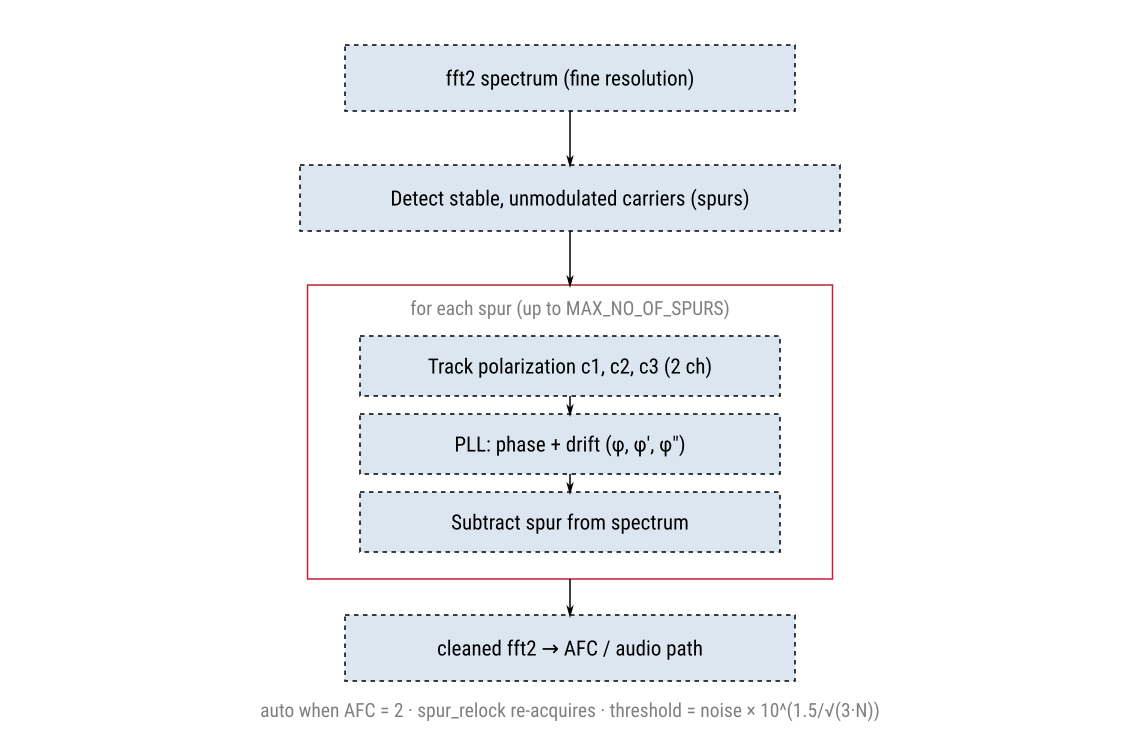
Spur removal cancels stable, unmodulated carriers — birdies, reference leakage, switching-supply lines — from the fine fft2 spectrum before AFC and the audio path use it. Each spur is modeled as a drifting complex sinusoid tracked by a PLL and (with two channels) on its own polarization, then subtracted.
Detecting spurs#
When AFC is in auto mode (genparm[AFC_ENABLE] == 2, wg.spur_inhibit == 0), Linrad searches the averaged spectrum for narrow peaks that stand above a noise threshold and are frequency-stable, adding them as spurs up to genparm[MAX_NO_OF_SPURS]. The search runs incrementally so it does not stall the DSP thread.
In the source
Driver spur_removal() — wcw.c:204 (called from second_fft()). Candidate search and setup: init_spur_elimination() and spursearch_spectrum_cleanup() in spursub.c; the threshold is noise × 10^(1.5/√(3·spur_speknum)) (spursub.c:93). Spur size constants: SPUR_N = 3, SPUR_SIZE = 8, SPUR_WIDTH = 7 (globdef.h:173, seldef.h:6); genparm[MAX_NO_OF_SPURS] and genparm[SPUR_TIMECONSTANT] (globdef.h:311).
Modeling and subtracting each spur#
For every spur, each new second-FFT frame updates:
- a PLL describing the spur's phase as a polynomial — phase, phase slope and phase curvature (
φ, φ′, φ″) — i.e. frequency plus drift, refined against the in-phase / orthogonal split of the measured signal; - (two channels) the spur's polarization
c1, c2, c3, from the same 2×2 covariance used for the wanted signal, so the spur is placed in one channel and noise in the other.
The modeled spur is subtracted from the spectrum. If the model drifts off the signal, spur_relock() re-acquires it.
In the source
Main loop eliminate_spurs() — spur.c:36; PLL update refine_pll_parameters() — spur.c:634 (uses spur_d0pha/spur_d1pha/spur_d2pha for φ, φ′, φ″); polarization update update_spur_pol() — spur.c:496 (same covariance form as fft3_mix2(), see diversity); subtraction remove_spur() — spur.c:596; re-lock spur_relock() — spur.c:682. Initial per-spur setup and polarization: initial_remove_spur() / make_spur_pol() in spursub.c.
Related#
Spur removal operates on the second FFT output and feeds AFC; its polarization tracking is the same computation as adaptive polarization and the pulse blanker.